Harbin: China's Frozen Wonderland
From frozen rivers and glowing ice castles to Russian architecture and unforgettable winter adventures, discover why Harbin is one of China's most magical destinations.
CHINA
Harriet Comley
7/11/20267 min read
Harbin (哈尔滨), the capital of Heilongjiang Province (黑龙江省), had been sitting at the very top of my China bucket list for years. In February 2026, I finally made the journey to China's far North East to experience one of the country's most extraordinary winter destinations.
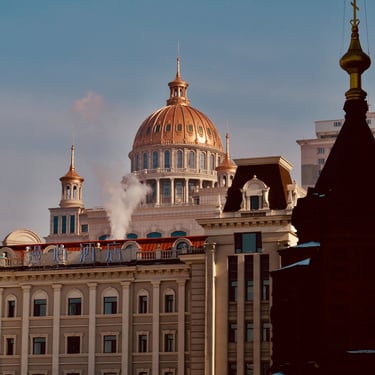
Located close to the Russian border, Harbin is unlike anywhere else in China. Its wide boulevards, grand churches, and elegant architecture reflect its fascinating Russian heritage, while every winter the city transforms into a frozen wonderland of ice sculptures, snow festivals, and rivers thick enough to walk across.
During my week in Harbin, I explored the world-famous Harbin Ice and Snow World (哈尔滨冰雪大世界), wandered through the historic streets around Saint Sophia Cathedral (哈尔滨圣索菲亚教堂), stepped on the frozen Songhua River (松花江), discovered hidden cafés and markets, and even ended up with frozen eyelashes after a random excursion with a Chinese girl and her brother to find Turkish delight giant ice cubes.
If you're looking for one of China's most unique cities, Harbin should be at the very top of your travel list.
At a Glance
Province: Heilongjiang (黑龙江省)
Population: Approximately 10 million
Nickname: China's Ice City (冰城)
Best time to visit: Late December to February (The Harbin Ice & Snow Festival typically runs within this time, but double check before booking)
Ideal trip length: 4–5 days
Nearest airport: Harbin Taiping International Airport (哈尔滨太平国际机场)
Top 10 Things to Do
1. Harbin Ice and Snow World
Chinese: 哈尔滨冰雪大世界
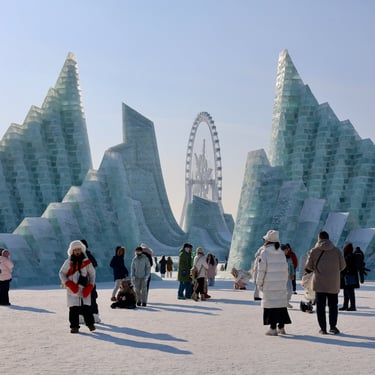
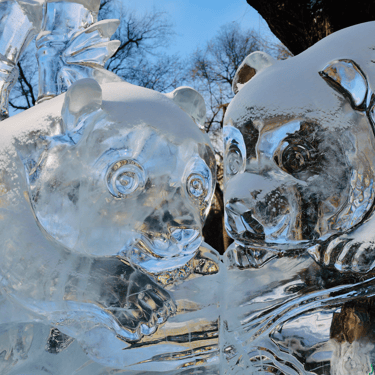
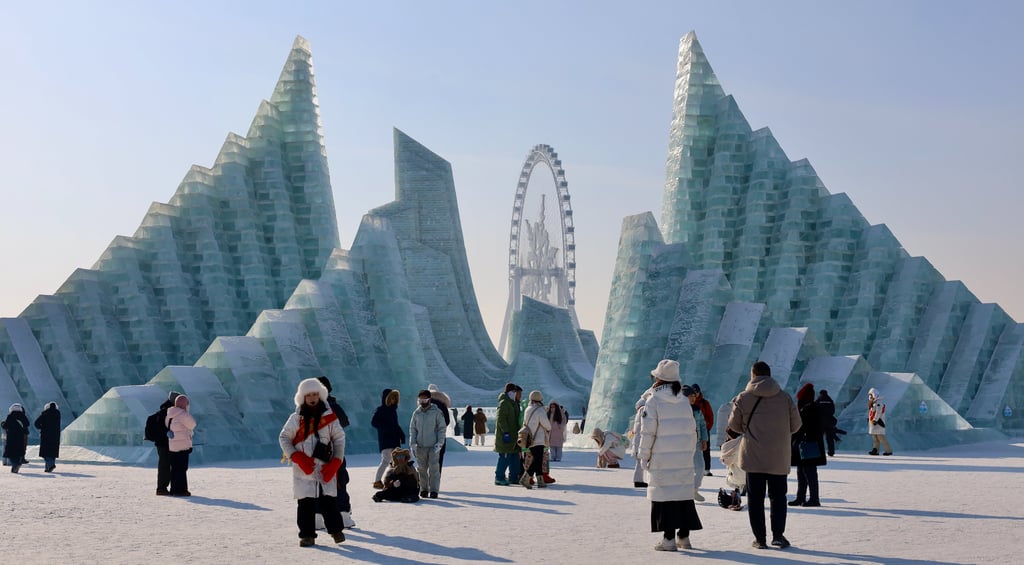
Without question, this is Harbin's biggest attraction. Every winter, thousands of enormous ice blocks cut from the Songhua River are transformed into illuminated castles, bridges, towers, and sculptures. I travelled here at the start of February, and I was really surprised how quiet it was, perhaps because it was almost the Chinese New Year holiday, so more people were preparing to go home rather than on holiday. I headed there in the afternoon for daytime photos and then you must stay for sunset and then nighttime for the lit up version of the sculptures. There are plenty of activities to do at the park too. There was a tiny ski slope, a Ferris wheel, snow mobiles, tire rides and slides.
You definitely cannot go to Harbin in winter without visiting the Harbin Ice and Snow Festival.
2. Saint Sophia Cathedral
Chinese: 哈尔滨圣索菲亚教堂
Built by the Russians in 1907, Saint Sophia Cathedral is one of China's most recognisable churches (and there aren’t so many around). Although no longer an active church, it remains one of Harbin's most iconic landmarks and tells the story of the city's fascinating multicultural history. The outside is really lovely, especially after some snow fall. As a European who has visited many building like this in Europe, the inside was less impressive, and certainly had a more modern feel to it, but regardless definitely worth a visit.
There are also a lot of photography services nearby, where you can pay to get dressed up in elaborate gowns and have your photos taken, a very normal thing to do for many Chinese tourists.
3. Central Street
Chinese: 中央大街
Stretching for over a kilometre, Central Street is lined with beautiful European style buildings, cafés, restaurants, souvenir shops, and bakeries. It is the perfect place for an evening walk, especially after fresh snowfall. I did find this street incredibly slippy after the snow, so wear good shows and be carefully, I have dodgy ankles so found myself shuffling precariously the whole way down. There are Russian style bakeries lining the street, so you can try some of their bread and pastries.
Whilst I actually found the temperature in Harbin to be a lot more bearable than people were making out on Xiaohongshu (小红书), I was surprised to see so many people eating ice cream! There are a couple of famous ice creams: a milk ice cream popsicle and another served in a giant, almost doughnut-style cone. I didn't try either, but I was surprised to see so many tourists trying them. To find these popular ice cream shops, you need no further directions than to head to Central Street (中央大街) and join one of the queues outside the shops.
4. Walk Across the Frozen Songhua River
Chinese: 松花江
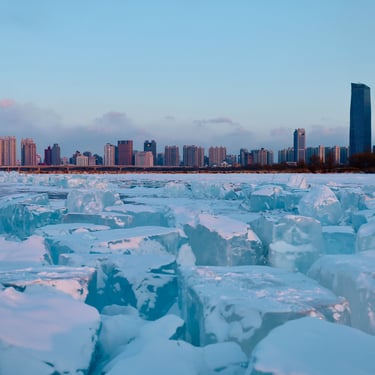
Seeing the Songhua River frozen solid was one of the most surreal experiences of my trip. During winter, the river becomes an enormous playground where people ice skate, ride snowmobiles, cycle across the ice, and even take horse drawn sleigh rides.
Standing in the middle of a frozen river is something I'll never forget.
5. Sun Island Snow Sculpture Art Expo
Chinese: 太阳岛雪博会
While Ice and Snow World focuses on illuminated ice sculptures, Sun Island is dedicated to giant sculptures carved entirely from snow.
The level of detail is amazing.
6. Stalin Park
Chinese: 斯大林公园
Located beside the Songhua River, Stalin Park is one of Harbin's most popular green spaces and a great place to watch local life unfold.
During winter it becomes a snowy riverside promenade.
7. Chinese Baroque Historic District
Chinese: 老道外
One of Harbin's most underrated attractions.
Unlike Central Street's Russian influence, Lao Daowai combines traditional Chinese architecture with European Baroque design, creating one of the city's most distinctive neighbourhoods.
8. Daoli Market
Chinese: 道里菜市场
If you enjoy experiencing everyday local life, don't miss Daoli Market.
You'll find fresh produce, local snacks, frozen seafood, and plenty of opportunities to sample Harbin's famous northern cuisine.
9. Volga Manor
Chinese: 伏尔加庄园
Located outside the city, Volga Manor recreates traditional Russian architecture in a peaceful countryside setting. I didn’t get around to checking out Volga Manor but I have included it on this list because it’s a popular among visitors.
10. Harry Potter Café
Chinese: 37号对角巷哈利波特主题咖啡馆
Calling all Harry Potter nerds (like myself). This is a must visit.
Now look, if I'm in another country or exploring a new city, I wouldn't usually do something like this. I love Harry Potter, but I despise the Disneyfication of life. I don't feel the need to constantly be doing things related to books or films. That being said, this is a fantastic place to stop for a little bit of warmth, and the café itself is epic.
You step inside and it's like a combination of The Burrow and Hogwarts. The place is jam packed. It's cluttered in the most beautiful way, with something to look at in every corner.
You do have to purchase a drink (one per person) if you want to access the dedicated Harry Potter section, where you can try on costumes and take photos. Honestly though, I found that part a little overrated. Simply sitting in the café and exploring the free areas was more than enough to enjoy the atmosphere.
Foods You Must Try
Harbin's location near Russia gives it one of China's most unique food cultures.
Don't miss:
• Harbin Red Sausage (哈尔滨红肠)
• Madie'er Ice Cream (马迭尔冰棍)
• Russian Bread (俄式面包)
• Guo Bao Rou (锅包肉)
• Dongbei Dumplings (东北饺子)
• Harbin Beer (哈尔滨啤酒)
Best Time to Visit
The best time to visit Harbin is between late December and early February, when the city is transformed by snow and ice.
Average winter temperatures range from –15°C to –30°C, so proper winter clothing is essential. I did a lot of research on Xiaohongshu (小红书) beforehand and, as someone who lived in Canada for a year, I honestly felt people were exaggerating how cold it is. If you're well prepared with your clothing choices and have a good pair of gloves, you shouldn't worry too much. Of course, everyone experiences the cold differently, but I found it much more manageable than I was expecting.
Getting Around
Harbin has an excellent metro system alongside taxis and DiDi.
Most major attractions are easy to reach, although Volga Manor requires a longer journey outside the city.
My Favourite Moment
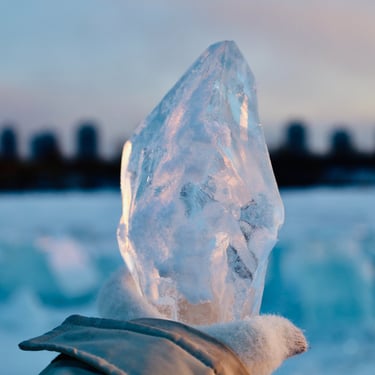
My favourite moment of the trip was visiting the Songhua River (松花江). I'd seen on Xiaohongshu (小红书) where they harvest the enormous blocks of ice used to build Harbin Ice and Snow World (哈尔滨冰雪大世界), so I was determined to find the location for myself.
After quite a long walk, I finally arrived, only to discover that the area had been turned into a tourist attraction. There were snowmobiles, winter activities, and an entrance fee if you wanted to get close to the ice harvesting site. I wasn't interested in paying for the excursion, I simply wanted to see where the giant blocks of ice came from.
While I was deciding what to do, I spotted a girl and her brother who looked just as confused as I was. I asked if they were also trying to find the ice, and together we decided to see if there was another way around.
So off we went.
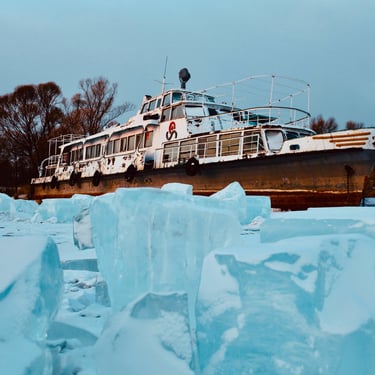
Instead of following the crowds, we walked all the way around the site, adding thousands of extra steps to an already long day. I think I ended up walking around 14,000 steps just during that part of the afternoon. Eventually we reached an old boat, frozen into the river, which you can see in the photos below. Of course, once winter arrives, the boats can't move because the river freezes solid around them.
Ironically, taking the long way round turned out to be the best decision we could have made. We ended up with an even better view of the giant ice blocks than the paying visitors, and there was nobody else around. It was quiet, peaceful, and felt like we'd stumbled across one of Harbin's hidden secrets.
As the sun began to set, we realised just how far we'd walked and decided we'd better make our way back before darkness fell over the frozen river. It also happened to be the only evening of the trip when my eyelashes froze, proof that Harbin's winter really does live up to its reputation once the temperature drops after sunset.
Eventually we said goodbye, each ordered a DiDi back to our hotels, and that was the end of one of my favourite travel days in China. Apart from skiing in Yabuli, which deserves its own article, this was undoubtedly the highlight of my entire Harbin trip. Sometimes the best travel memories aren't the famous attractions at all. They're the unexpected adventures that happen when you decide to take the long way round.
Travel Tips
1. Visit Ice and Snow World before sunset and stay after dark.
2. Carry a power bank—cold weather drains phone batteries very quickly.
3. Get some of those gloves that you can use with a phone
4. Keep the Chinese names of attractions saved on your phone for easy use in maps (download AMaps) and taxis.